Commercial Invoice Explained: Definition, Importance, Key Elements & Example (2026 Guide)
What is a commercial invoice? Learn its definition, why it matters in international trade, the 10 key elements it must include, and see a real example — plus a free template.
A commercial invoice is one of the most important documents in international trade. It is issued by the seller (exporter) to the buyer (importer) and provides a detailed description of the goods sold, their value, and the terms of the sale. Customs authorities rely on it to assess duties and taxes and to regulate the flow of imports and exports.
What is a commercial invoice?
A commercial invoice is a legal document issued by the exporter to the importer in an international trade transaction. It acts as both a request for payment and a customs declaration, listing the goods, their value, the country of origin, and the agreed terms of sale (Incoterms®).
In simple words
A commercial invoice is a bill from the seller to the buyer that shows what goods were sold, their value, and the terms of the sale. It helps customs calculate duties and ensures smooth clearance of goods across borders.
Commercial invoice vs proforma invoice vs regular invoice
| Document | Purpose | Legally binding? | Used for customs? |
|---|---|---|---|
| Proforma invoice | Quotation before the sale | No | No |
| Commercial invoice | Final bill after shipment | Yes | Yes |
| Regular (tax) invoice | Domestic sale record | Yes | No |
If you're comparing invoices with other transaction records, see our guide on the difference between an invoice and a receipt.
Why a commercial invoice matters
- Customs clearance — Without it, your shipment cannot legally cross borders.
- Duty & tax calculation — Customs officials use the declared value and HS codes to assess import duties.
- Proof of transaction — Serves as legal evidence of the sale between exporter and importer.
- Foreign exchange & payment — Banks require it to process international payments and letters of credit.
- Trade statistics & compliance — Governments use it to track imports/exports and enforce trade regulations.
10 key elements of a commercial invoice
Every commercial invoice should include the following:
- Seller (exporter) details — Name, address, phone, email, tax ID.
- Buyer (importer) details — Name, address, phone, email.
- Invoice number and date — Unique reference and issue date.
- Description of goods — Clear, specific description of each item.
- Quantity and unit price — Number of units and price per unit.
- Total invoice value — Subtotal, freight, insurance, and grand total.
- Country of origin — Where each item was manufactured.
- HS code — Harmonized System code for customs classification.
- Incoterms® — Agreed shipping terms (e.g. FOB, CIF, EXW, DDP).
- Payment terms and seller's signature — When and how payment is due.
Example of a commercial invoice
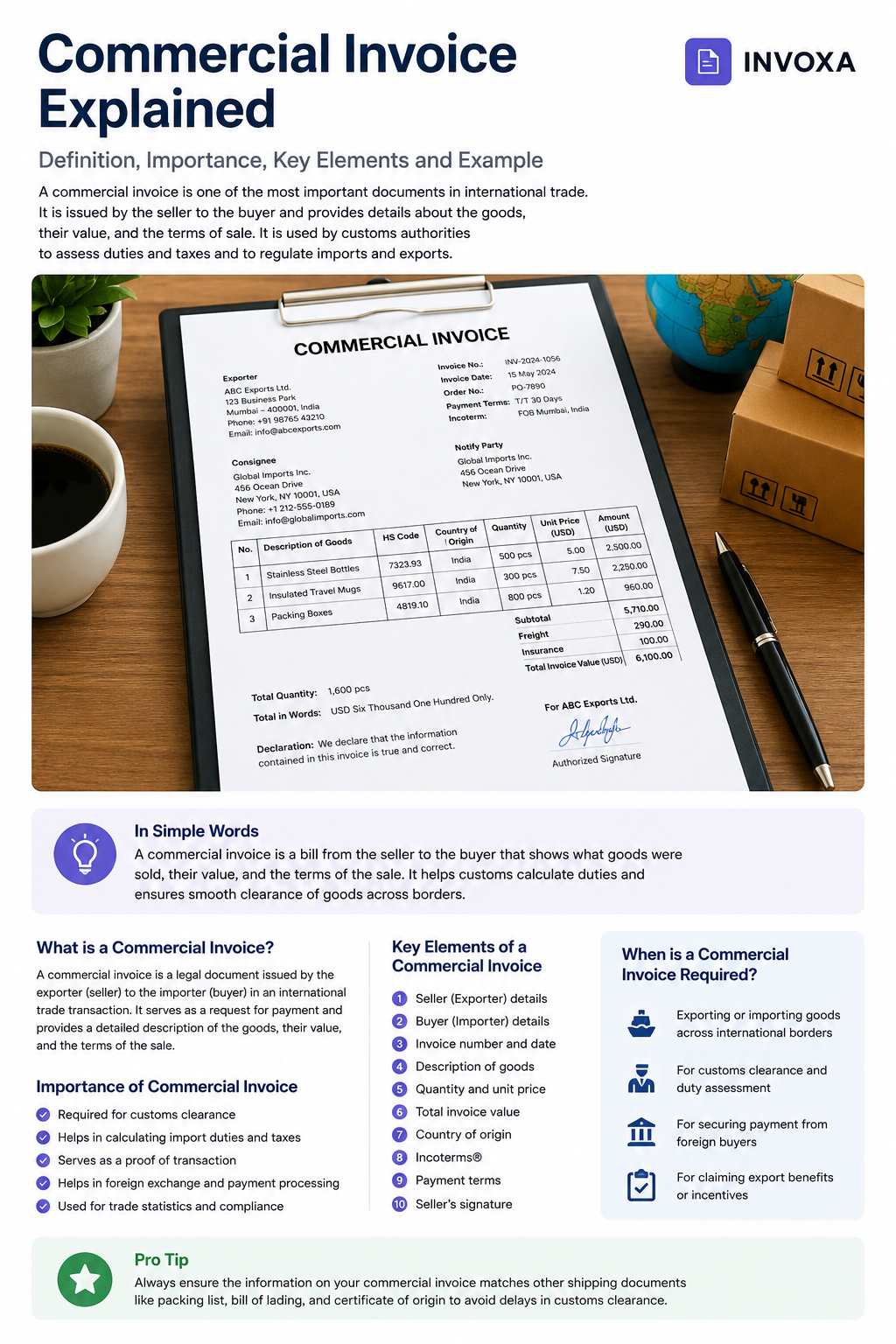
Below is a simplified example of what a real commercial invoice looks like:
| No. | Description of Goods | HS Code | Origin | Qty | Unit Price (USD) | Amount (USD) |
|---|---|---|---|---|---|---|
| 1 | Stainless Steel Bottles | 7323.93 | India | 500 pcs | 5.00 | 2,500.00 |
| 2 | Insulated Travel Mugs | 9617.00 | India | 300 pcs | 7.50 | 2,250.00 |
| 3 | Packing Boxes | 4819.10 | India | 800 pcs | 1.20 | 960.00 |
- Subtotal: 5,710.00
- Freight: 290.00
- Insurance: 100.00
- Total invoice value: USD 6,100.00
When is a commercial invoice required?
- Exporting or importing goods across international borders
- Customs clearance and duty assessment
- Securing payment from foreign buyers (letters of credit, wire transfers)
- Claiming export benefits, incentives, or duty drawbacks
How to create a commercial invoice (step by step)
- Add exporter, consignee, and notify party details.
- Assign a unique invoice number and issue date.
- List each product with HS code, country of origin, quantity, and unit price.
- Add freight, insurance, and any discounts.
- State Incoterms® and payment terms clearly.
- Sign and stamp the invoice before shipping.
You can generate a professional commercial invoice in under a minute with our free online invoice generator — no signup required.
Pro tip
Always ensure the information on your commercial invoice matches other shipping documents like the packing list, bill of lading, and certificate of origin. Any mismatch can cause costly delays in customs clearance.
Frequently asked questions
Is a commercial invoice the same as a tax invoice?
No. A tax invoice is used for domestic sales and shows GST/VAT. A commercial invoice is used for international shipments and is used by customs authorities to assess duties.
Do I need a commercial invoice for samples or gifts?
Yes. Even for samples, gifts, or goods of no commercial value, customs requires a commercial invoice with a declared value (often marked "Value for customs purposes only").
Who issues the commercial invoice?
The exporter (seller) issues the commercial invoice to the importer (buyer) before or at the time of shipment.
What currency should a commercial invoice be in?
Usually the currency agreed in the sales contract — most commonly USD or EUR. Some countries require the invoice in the local currency of the importer.
Does a commercial invoice need a signature?
Most customs authorities require a signature from an authorized representative of the exporter. Digital signatures are increasingly accepted.
How long should I keep commercial invoices?
Most tax and customs authorities require you to retain commercial invoices for 5 to 7 years for audit purposes.
Create commercial invoices with Invoxa
Invoxa lets you create, send, and track professional commercial invoices in seconds — with multi-currency support, custom tax fields, HS codes, and Incoterms® built in. Start free or try the free invoice generator first.