Deposit Invoice Template (with Sample & Free Download)
Free deposit invoice template with real examples. Learn how much to charge, when to send, and how to legally protect yourself with upfront payments.
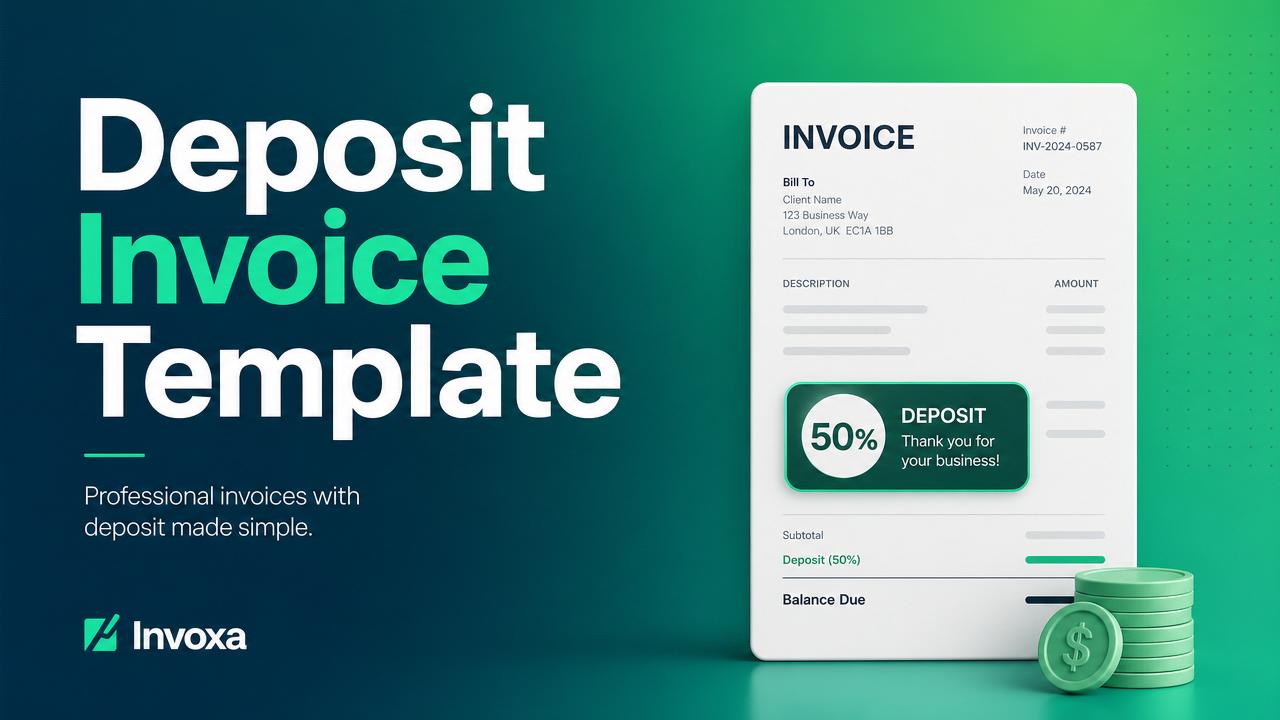
What is a deposit invoice?
A deposit invoice requests partial payment (typically 20-50%) before work begins. It''s standard for design projects, construction, custom development, events, and any service where materials or time is committed upfront.
Unlike a final invoice, a deposit invoice creates a contractual commitment: the client has paid, so they can''t vanish; you''ve accepted funds, so you owe the work.
When to use a deposit invoice
- Project value over $1,000
- Custom or non-refundable work (design, dev, event bookings)
- Long-lead materials (branded merch, print runs)
- New clients with no payment history
- Anything over 30 days of scheduled work
Standard deposit percentages by industry
| Industry | Typical deposit | Balance timing |
|---|---|---|
| Freelance design | 50% | On delivery |
| Web development | 30-50% | Milestones (25/25/25/25) |
| Construction / contractors | 10-30% | Milestone-based |
| Event planners | 25-50% | 30 days before event |
| Photographers | 25-50% | On the day |
| Consultants | 50% | Monthly retainer |
What a deposit invoice must include
- Clear label — "DEPOSIT INVOICE" in the header
- Deposit amount and % — e.g. "50% deposit of $4,000 project total"
- What the deposit covers — brief scope
- Balance due terms — when the remaining amount is invoiced
- Refund policy — is the deposit refundable, and under what conditions
- Project start conditional — "Work begins on receipt of deposit"
Sample deposit invoice
DEPOSIT INVOICE #DEP-2026-018
Date: May 20, 2026

Bill to:
Acme Corp
123 Business Way

Project: Website Redesign (Statement of Work dated May 15, 2026)
Total project value: $8,000

Deposit (50%): $4,000
Balance due on delivery: $4,000

Payment terms: Due on receipt.
Work begins on receipt of deposit.
Deposit non-refundable after design phase kickoff.

Total due now: $4,000
Deposit vs. retainer vs. down payment — what''s the difference?
| Term | Meaning |
|---|---|
| Deposit | Partial payment against a specific project total |
| Retainer | Recurring fee reserving your availability |
| Down payment | Common in retail/goods, similar to deposit |
| Advance | Broader — includes deposits, retainers, prepayments |
Refundable vs. non-refundable deposits
Non-refundable protects you when clients back out after you''ve committed time. Enforceable if the contract clearly states it and the amount is reasonable (a "genuine pre-estimate of loss," in UK/EU law).
Refundable is friendlier for new clients but risky for long-lead projects.
Best practice: partially refundable — e.g., "Refundable up to project kickoff. Non-refundable after design phase begins."
How to send a deposit invoice professionally
- Send the SOW / contract first
- Send the deposit invoice after the client signs
- Include the payment link (Stripe, bank details, or Invoxa''s hosted invoice page)
- State clearly: "Work begins on receipt"
- Send the final invoice against the same reference on delivery
FAQ
Is a deposit invoice taxable? Yes — the tax point (in most jurisdictions) is the earlier of invoice date or payment received. Add VAT/GST on the deposit invoice, not just the final.
Can I charge a deposit without a contract? Legally yes, but you''re unprotected. Always pair a deposit invoice with a written SOW or contract.
What percentage deposit should I ask for? 50% is safe and standard for freelance work. For long-lead projects, break into milestones (30/30/40 or 25/25/25/25).
Do I refund a deposit if the project is cancelled? Depends on your contract. Non-refundable clauses are enforceable if the amount reflects real loss. Always be transparent upfront.
Can I automate deposit invoices? Yes — with tools like Invoxa''s partial payments, you can split invoices, track deposits and balances, and auto-send reminders.
Next steps
- Draft your standard deposit terms once, reuse across clients.
- Never start work before the deposit clears.
- Track deposits and balances in one system so nothing slips.