Invoice Footer Best Practices: What to Include (with Examples)
Exactly what to put in your invoice footer in 2026: payment terms, bank details, tax IDs, late fees and legal must-haves by country — with a copy-paste checklist and ready-to-use examples.
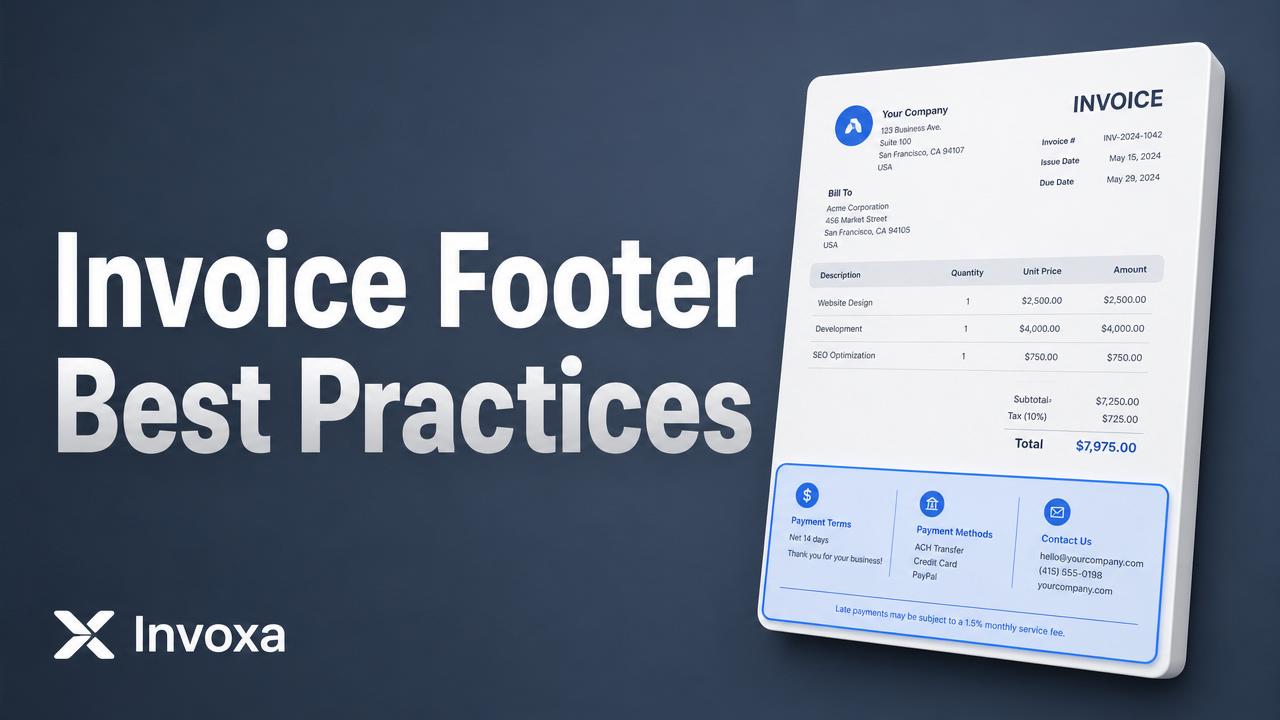
Most people obsess over the invoice header and line items, then paste "Thank you for your business" in the footer and call it done. That is a missed opportunity. The invoice footer is where you set expectations, reduce disputes, and — done right — get paid faster.
Short answer: a good invoice footer contains payment terms and due date, accepted payment methods with full bank/payment details, a late-payment clause, your tax identifier (VAT/GST/EIN/ABN), a billing contact, and a one-line thank-you. Keep it under 10 lines.
Quick checklist: what to include in an invoice footer
| Element | Why it matters | Required? |
|---|---|---|
| Due date + payment terms (Net 15/30) | Removes ambiguity, the #1 cause of late payment | Strongly recommended |
| Accepted payment methods + details | Client can pay without emailing you back | Yes |
| Bank / IBAN / reference number | Enables reconciliation | Yes for transfers |
| Late payment fee or interest clause | Legally enforceable deterrent | Recommended |
| Tax ID (VAT, GST, EIN, ABN) | Legal validity + client's deduction | Often mandatory |
| Registered company name & address | Mandatory in EU/UK/AU | Often mandatory |
| Billing contact (name + email) | Speeds up query resolution | Recommended |
| Link to terms / refund policy | Dispute protection | Recommended |
| Thank-you note | Relationship, tone | Optional |
What is the invoice footer?
The footer is everything below the totals: payment instructions, terms, legal notices, and closing message. It is the last thing the client reads before paying — treat it like a landing page.
What to include in your invoice footer
1. Payment terms
State the payment due date clearly ("Net 15 — due by 5 Aug 2026"). Ambiguous "due on receipt" wording is a top cause of late payments.
2. Accepted payment methods
List them explicitly with instructions:
- Card — pay online via the link above
- Bank transfer — Acme Ltd, Sort 12-34-56, Acct 12345678, ref
INV-2026-001 - UPI / local rails — where your clients actually pay
3. Late payment policy
E.g. "Payments received after the due date will incur a 1.5% monthly late fee." Naming a specific figure makes the clause far easier to enforce than "late fees may apply".
4. Tax identifiers
Include your VAT / GST / EIN / ABN number where legally required. Missing tax IDs can invalidate the invoice for the client's deduction.
5. Refund and dispute policy
A one-line pointer to your terms URL — e.g. "Refunds per terms at yourdomain.com/terms" — protects you in disputes.
6. Contact for questions
Name + email of who to contact for billing questions. Do not send them to a generic support inbox.
7. A brief thank-you note
"Thanks — it has been a pleasure working with you." Warm, human, one line. Skip the emoji.
Legal requirements by region
Rules differ, and the footer is usually where the compliance details live. Always confirm with your local tax authority or accountant.
- United Kingdom — VAT-registered businesses must show the VAT number, VAT rate and VAT amount; limited companies must show the registered company name, number and registered office address.
- European Union — VAT number of the supplier (and the customer for reverse-charge B2B sales), plus a reverse-charge note where it applies.
- India (GST) — GSTIN, place of supply, HSN/SAC codes and the CGST/SGST/IGST split. See our GST invoice guide for India.
- United States — no federal invoice format, but include your EIN when a client requests it for 1099 reporting, and state sales tax registration details where you collect tax.
- Australia — a valid tax invoice needs your ABN and the words "Tax Invoice"; GST amount must be shown.
Footer examples by business type
Freelancer / consultant
Payment due: 5 August 2026 (Net 15)
Bank transfer: Acme Studio Ltd • Sort 12-34-56 • Acct 12345678
Reference: INV-2026-001
Late fee: 1.5% per month after due date.
VAT No: GB 123 4567 89
Questions? billing@acme.studio
Thanks — glad to be working with you.
Agency with deposits
50% deposit due on receipt; balance due Net 30 on delivery.
Work pauses if the deposit is unpaid for 7 days.
Pay online via the "Pay Now" link above, or by transfer (details above).
Terms: acme.agency/terms  •  VAT No: GB 123 4567 89
Trades and services
Payment due within 7 days of completion.
Card payments taken on site. Bank transfer details above.
Materials guarantee: 12 months. Labour: 6 months.
ABN 12 345 678 901 — Tax Invoice
What NOT to put in the footer
- Long marketing pitches — this is a bill, not a newsletter.
- Legal disclaimers in tiny print — link to your terms instead.
- Payment method fees the client did not agree to — surprise fees cause disputes.
- Multiple bank accounts across countries — pick one; ask if the client needs an alternative.
Common invoice footer mistakes
- No reference number in the bank line — payments arrive unmatched and sit unreconciled for weeks.
- "Due on receipt" — legally vague; use a dated deadline instead.
- Stale bank details — one changed account number turns into a month of chasing.
- Terms only in an attachment — if the client never opens it, enforcement gets harder.
- A footer longer than the invoice — anything past ten lines gets skimmed.
Best practices
- Keep it under 10 lines — dense footers get skimmed.
- Bold the due date — one visual anchor.
- Match your brand — same font, same tone as the rest of your invoice.
- Localize — bank details, tax IDs, and dates in the client's format.
- Test one change at a time — measure days-to-pay before and after.
How Invoxa helps
Invoxa lets you save a default footer template per account, override per client, and auto-fill tax IDs, bank details, and payment links. Pair with the free invoice generator to see a well-formatted footer live, and read what a professional invoice should include for the rest of the document.
FAQ
Is a footer required on an invoice? No — but a footer with payment terms and tax IDs is a legal requirement in most jurisdictions for a valid tax invoice.
What should an invoice footer say? Due date and payment terms, how to pay (with bank or payment-link details and a reference), a late-fee clause, your tax ID and registered details, a billing contact, and a short thank-you.
Where should late-fee terms go? Either in the footer or in a linked terms document referenced in the footer. Whichever, the client must be able to see them before the due date.
How long should an invoice footer be? Aim for six to ten lines. Long footers get skimmed and bury the due date.
Can I use different footers for different clients? Yes — Invoxa supports per-client footer overrides.
Should I include my logo in the footer? Optional. Logos usually live in the header; the footer is for text-based details.
Do I need my VAT or GST number in the footer? If you are registered, yes — most tax authorities require the identifier on the invoice, and clients need it to reclaim tax.